Tuesday, May 24, 2016

The 30th Anniversary of Hands Across America

It's the week of the 30th anniversary of Hands Across America  a historical event and a collective experience if there ever was one.

A couple of years ago, a relative from an older generation gave my daughter a small bag full of hand-me-down mementos from her jewelry box -- old buttons, little pieces of ribbon from gifts once given, lapel pins, and other trinkets. When my daughter came home to show me her new treasures, my heart skipped a beat as a little pin reflected a sparkle of light and instantly conjured up memories from my Gen X childhood.  It was a Hands Across America pin.  Something that didn't mean much more than a spare button to the person who originally had it, and something that looked only like a symbol for a string of paper dolls to my daughter, but something that means a lot to me because of the history it is connected to.

Hands Across America, an event organized by Ken Kragen, raised millions of dollars that were distributed to charities across the country. To be a part of the chain, you were asked to submit $10, and the money was used to help Americans living in poverty. Other than it just being a one-day event, the idea was to raise awareness of the effects of poverty in America in a broader and more long-term sense -- to help people think about how they could be continually involved by doing volunteer work or contributing  in other ways. The chain went from New York City to Long Beach. Of course there were breaks in the chain of people, and apparently in some places where the desert sun was too hot,they used stretches of ribbon to connect people to each other.  


Even though the 1980's were full of materialism and vanity, there were these events, these bright points, that became part of the history of that decade, like Live Aid, where people united themselves to help others on a large scale. I think those big events that happened in the mid 1980's had a lot to do with who I became as a person.   As Gen Xers who were kids and teenagers at the time, these bright points not only were a part of what formed our collective consciousness, but also our collective conscience. Celebrities of the time were a part of the Hands Across America promotional video and part of the chain itself. In the video, we see young faces of people that are now much older and faces that we miss of those who have since passed away.  The event came right through my city at the time, Albuquerque, NM, and the celebrity who made a local appearance for the event was Don Johnson. I didn't get to be a part of that day, but I do remember watching the Hands Across America promo video in the same classroom where I watched The Challenger Disaster earlier that same year. 1986 fell right in the middle of my formative years and holds a large number of my Gen X memories, including Chernobyl, and the beginning of the Iran-Contra affair.   It was a year that showed me that even though the world is full of much confusion, disappointment, and suffering, we are capable of great things when we come together for a cause larger than ourselves. When 1986 began, we could not have known how much history was unfolding around us, or what an enormous role it would have in forming who many of us became as Generation X adults.  

__________________
(C) 2016 writing and photo by Chloe Koffas, all rights reserved

Tuesday, April 26, 2016

The Psalms - Why What is Beautiful is What is Real

Fuller Seminary, a theological graduate school, recently launched Fuller Studio, a place to embrace a wider circle of voices from around the world.  This includes intercultural conversations on the Christian faith, along with women's issues in the leadership of the church, and interfaith dialogue. Recently, Fuller Studio released a short film that includes conversation between Bono and Pastor Eugene Peterson about The Psalms from the Bible, and about The Message, a version of the Bible which Peterson translated from the original Hebrew and Greek into English in an idiomatic sense and in contemporary language - an extraordinary scholarly effort both of the mind and of the heart.  

An afternoon spent in a cozy lakeside cabin with a mug of hot coffee, in a discussion about  literature, art, and theology near a crackling fire with kindred souls, I can't imagine a place I'd rather be....


The Psalms are full of the rawness about the agony of life, the questions we have that can go unanswered for so long, and the deep sorrow, despair, and confusion we all experience.   The Psalms are beautiful because they are real.   Praying, in the way that the Psalms are prayed, isn't being nice before God, says Peterson, it's not pretty.  It's honesty, brutal honestyBono said he would like to see more of this type of realism in life and in art and in music - write about a bad marriage you had, he says, write about why you are pissed off at the government....

U2 had an enormous impression on my spiritual life in my formative years growing up Generation X, and they still do. I spent some Sundays of my childhood in church surrounded by Protestant hymns from the last two centuries; I spent some afternoons of my twenties listening Catholic Gregorian chant CDs, and now my Sunday mornings might include Russian chant of the Orthodox liturgy, yet to be honest, nothing reaches my soul or connects me to God like the music of U2. On that same wavelength, while I appreciate reading or hearing Scripture in any translation of the original text, I truly love experiencing it in my own context - in contemporary language that resonates with the relationship I have with the English language - including the metaphors I already understand. This is a profound comfort to me, and because of Peterson's research and translation, we have this. What U2 has done, and what Eugene Peterson has done for contextualizing Scripture into our modern lives, is very similar.  Many thanks to both of them for what they have done for Generation X. As a quintessential Gen Xer, I can say that both of them have helped make my faith more beautiful, both of them have made my faith more real.

Bono often reads (or sings) from the Psalms during U2's concerts. If you are interested in reading the Psalms that Bono refers to in the film as they are translated in Eugene Peterson's The Message you can download the first 40 of them for free here.


__________________________

(c) 2016 -  writing by Chloe Koffas -
feel free to leave a comment, or to email me directly here: genxpixels@gmail


Sunday, April 10, 2016

Fighting for X: The Legacy of Fred Rogers


Watching Mr. Rogers put on his cozy, brightly colored sweaters and change into his navy blue sneakers (that now look simultaneously retro and timeless) was a truly comforting ritual for me as a three year old playing with Lincoln Logs in front of the TV.

wqed.org
What I did not know as a Gen X tot of the late 1970's was this man was much more dimensional than the simple lessons he taught me, he was someone who actually fought for my generation.

I remember being a toddler and experiencing this new found fear of going down the bathtub drain - but not for long. That same week, coincidentally, there was a Mr. Rogers episode where he talked about this very subject, and he reassured me that it was impossible and explained exactly why. I distinctly remember how he would look at me from the screen with his compassionate eyes, like he was reaching out to me individually, reassuring me that everything would be okay. And while our fears change as we get older, isn't that what we really want, to know that everything is going to be okay?

As a preschooler, I found the cadence to his voice peaceful and comforting - he spoke slowly enough for me to clearly understand him, unlike Walter Cronkite and news anchors I would see who spoke so fast about a world I couldn't understand, that I couldn't follow along at all. In the 1970's, many of our living rooms had box shaped TVs that were actually colossal pieces of furniture, and since the screen was near to the floor, he would speak to me, on my level, in every sense.  

As time went on and I got past first grade, when flipping through the channels to find some cartoon, I would come across his show and I would see his preschool vernacular through the eyes of an older child - I wasn't sure why he spoke the way he did - it seemed a little too slow or even off-putting. As an adult I can see that the way he spoke came from profound wisdom and love. My first generation American Gen X husband watched Mr. Rogers as he was learning English as a second language and heading toward kindergarten in the early 1980's, and this is one piece of what helped him learn English so quickly. Many immigrant parents probably found comfort in the slower pace of his voice - in understanding what he was saying as their kids were educated by his show. Because of his deliberate, slower pace, children with different levels of hearing impairment could also watch his show and follow along much easier than on other shows. He had a way of reaching out to kids from every socioeconomic background, culture, and situation.


You've probably seen the famous footage online of Fred Rogers addressing the U.S. Congress for much-needed funds for PBS. He gave this speech in 1969, when the first wave of Generation X was very young, and the second wave was about to be born.  While he is fighting for children's educational programming on public television, he was in fact fighting for Generation X.

There is something noble about fighting for people that are your own race or your own generation, and there is something even more noble about fighting for people that are of a different race or a different generation, because you have much less, or probably even nothing, to personally gain as a result. Gen X grew up in a time when every area of society crumbled around us, where lies and hidden stories that surfaced about prominent leaders in our society caused us to become a cynical generation. Yet Mr. Rogers gave us a reason to have hope that there are truly good, sincere people in the world.

PBS.org
Mr. Rogers was an ordained minister. In seminary, he narrowed down on his calling, not one of a traditional church pulpit ministry, but one that was profoundly creative - using the medium of TV to help people - specifically children. When I look at the work of Mr. Rogers through a theological lens, this is how I see the set of his show: he would enter the show on a platform that reminds me of an elevated wooden pulpit, ones like you might see in certain traditional or formal churches, and then he would step down from it, to meet us where we were.  I feel that his brightly colored sweaters were his his simple vestments, and he would change them like a priest changes vestments for the liturgical seasons.  At the beginning of each show, as he takes off his formal jacket to put on a casual sweater, as if to say that he might have been a man with a pastoral title and a divinity degree, but he was going to keep it simple and light so that we could let down our guard. He never talked about God on the show because it was unnecessary - it was already clear that God was with him by the light that sparkled from his eyes, and that God was with us, especially when we learned that we were lovable for being our true selves. Of all the times in life that people told me that they liked me (except they wished I would lose some weight) or that people told me they liked me a lot (but they wished I would wear nicer, designer clothes) or that they loved me (but I needed to change to who I was) it was vital to have a foundation in life that I could be "deep and simple, not shallow and complex".

There are more than enough of us Gen Xers who have been wounded by churches, who have been betrayed by people in church leadership, who have given up on church altogether, or who struggle to get ourselves to church at all, not only because society taught us to mistrust institutions as we grew up, but also because when we did somehow manage to get ourselves to church, people in power were abusive toward us. And that is why was so important to us for there to be someone, even just one person, for us, who was alive in our lifetime who was a true beacon for God to us, who gave us substance, who had no dark back story or double life, who was genuine and respectable. The more you read about Mr. Rogers, the more you see what he meant to our generation collectively and individually.


A private disagreement he was having with his wife was accidentally picked up by an audio recorder on the set of his show in 1981. This was the year when the divorce rate in America was at its peak. This is what he said to his wife: "Sometimes when we disagree, I feel frustrated.  But I never forget how lucky I am to have you in my family. Always remember how special you are."  He was also a father, and a grandfather.  He was from the Silent Generation, and his second son is Generation X.  Not only was he was a Presbyterian minister, he was many other things simultaneously - including an author, a composer, and an activist: 

"When I say it's you I like, I'm talking about that part of you that knows that life is far more than anything you ever see or hear or touch. That deep part of you that allows you stand for those things without which humankind cannot survive.  Love that conquers hate, peace that rises triumphant over war, and justice that proves more powerful than greed."

Here is a link that includes more about his life story:

Weaving a Magnificent Life Tapestry

Photo by Jim Judkis


While I say that he fought for X - he was a fighter in the sense that he disarmed people with his truth and love. He had a way of connecting with people, maybe because of his profound love for each person he met, maybe for the Imago Dei that he saw in every person.  You could see it on his show, you can see it in photos. In this photo: a sweet Gen X boy, Tommy, born in 1973 with hydroencephalitis and who was abandoned by his birth mother. He passed away in 2011. This photo went viral after the Sandy Hook school shooting with words of wisdom from Mr. Rogers about when tragedy occurs.
There are so many amazing quotes by Fred Rogers, there are some you already know, and there are some that might surprise you - click here to see a list of them:


Gen Xer, Rolling Stone Magazine writer, and MTV news producer Benjamin Wagner was the actual next door neighbor of Mr. Rogers. He and his brother Christofer recently created a beautiful documentary on life of Fred Rogers that has already won awards at multiple film festivals: 


In case you didn't know it, Gen Xers, Mr. Rogers left a message for you just before he passed away in 2003, this is his goodbye to us....

He wanted you to know that he is so proud of you.  
He knows how hard it can be to look toward the future with hope.  
He wants you to know that the message he gave you as a child is the same one he gives you now - you are valued, you are valuable, 
and he wants you to pass this on to the next generation.    

When I look at the whole of Fred Roger's life, I cannot get over the kind of person he was -  he was a fatherly presence to a fatherless generation. His legacy spans beyond Generation X, it spans out to all children who are and will be affected by what he taught. He knew what his calling was, and he followed it with grace, creativity, and originality. So far, in all my years of researching and writing about Generation X, I haven't found anyone outside of our generation who has ever fought for us in the way that he did. He stood up for us in front of the U.S. Congress, and delivered a speech that got the funding for a show to go on the air that helped us deal with our fears, and manage life, and growing up. He changed the course of many of our childhoods, he changed the course of mine. 

Thank you, Mr. Rogers, for what you did for my generation.

"One of the greatest dignities of humankind is that each successive generation is invested in the welfare of each new generation." - Fred Rogers 1928-2003


_____________________________________________________________________
(c) 2016 - writing by Chloe Koffas - all rights reserved 


A huge thank you to everyone who has, and who does contribute to PBS.  

Thursday, January 28, 2016

The Challenger Disaster and Generation X


As the sun rose on America that January morning, some cities lay quietly under a blanket of snow, and while the Atlantic waters lapped onto the shores of the Southeast, a threatening chill arrived with them.


As the 30th anniversary of the Challenger Disaster is commemorated and the events of that day surface once again in the media, for some of us of a certain age, the tragedy of that day is with us all the time


I was a child of the '80s, and in the months leading up to that day, the Challenger was constantly on my mind - like in the afternoons when I would run in circles and land on my back in soft green patches of clover in the park near my house. Through my nine-year-old eyes, I'd look out to the infinite blue of the universe, to the east where shuttles are launched, to where impossible things seemed possible, even if just for one minute.


In the mid '80s, while the members of Generation X were growing up, modern American public educations standards were at an all-time low. The Reagan Administration saw the upcoming Challenger launch as a way to remind the nation of the important role of teachers and maybe to reboot hope in the American school system. Out of thousands of applicants to the Teacher in Space Project, the charismatic Christa McAuliffe was chosen. Those of us in elementary school closely followed these events from sources like NASA and Weekly Reader, so that these people would continually be on our minds, so that they could, in every sense, become our heroes, so that we could know their stories and their lives, so we would love them.

The pint sized propaganda was delivered to our desks every week, and we drank every drop of it.  By design, the anticipation of the launch hit every major nerve in me - the women among the crew became role models to the Cabbage Patch-carrying girls of the 1980's.


In this Morning in America era, every kid you knew was dreaming of being an astronaut. On the playground, we would tell each other which of the seven was our favorite. In one way or another, every one of the seven carried with them the hopes and aspirations of our generation. Whenever I have asked fellow Gen Xers about their recollection of that day, those in elementary school were often the most impacted. Those about halfway through elementary school, like myself, were old enough to intellectually grasp the significance of this day and yet were still young and tender enough for the event to inflict powerful emotional damage. Because the Challenger launch became synonymous with our education and our hope in our future, the tragedy of that winter day is one of the main reasons my generation instinctively distrusts institutions. While there was a spectrum of responses to the event, ranging from confusion to grief, the school kids affected the most will tell you that day changed their lives. I can tell you that it changed mine. It was a day that left my generation standing alone, in a "sunlit silence".

Custom watercolor by Emblaester, artist on Fiverr.com

If I allow my mind to fully go back into the moments of that day, it is hard to breathe. I can still feel the chill of that morning on my skin from where I was two time zones away from Florida in the high altitude desert of New Mexico. I saw it live on TV from a classroom, along with millions of other kids, and watched quietly as the twisting contrail imprinted itself as an image of horror onto the collective consciousness of my generation, like some coiled up snake that struck without warning. Palpable feelings of excitement degenerated into confusion and then anxiety; and then the teacher abruptly shut off the TV. We were told that it was over and to get back to our desks. In that moment that I was supposed to stoically return to school work, I found myself caught in some delicate place between life and death, somewhere between hope and hopelessness. It took me the whole day to process what had happened, and as I did, an emptiness hovered above my head, above my school, above my country.


So much dialogue was happening in our classrooms in the months leading up to that day about how anything was possible, that we could be astronauts, that we could be anything we wanted when we grew up, and that the shuttle launch was going to be the moment that would demonstratively prove this to us. When the moment defining how anything was possible went entirely wrong, I felt panicked to my core - maybe my future was going to be dark, maybe my dreams would be swallowed whole with no explanation. Not only did our heroes die that day, but a lot of our hope did, and much of this hope was replaced with fear about the future - an anxiousness that has stayed with us our whole lives. Many of the traits that Generation X is known for, from our negativity to our cynicism, can be traced back not only to the state of society in our formative years, but to the exact date of January 28, 1986.

That evening, millions of us gathered around TVs once again, and this time it was to watch Reagan deliver a speech about the catastrophe. His words made the event unbearably real, and while he spoke, my heart was forced to shift from somewhere within the first stage of grief, denial, to somewhere within the dark gravity of the next stage of grief - anger. The only words from the speech that gave me any comfort were that our fallen heroes had "touched the face of God." When he quoted the poetry of aviator John Gillespie Magee Jr. in the speech, I did not know that he, too, had died at a far too young age - during WWII. I could not yet fully know of the service and suffering of the GI Generation before me, of all who had lost their lives in order to pass on freedom before my own generation was ever born.  And what the older generations did not know, was that, as icicles formed around the shuttle that night before, that the world had already had become a much bleaker place than the one they thought they passed on to us, and when morning came, the disaster confirmed it.


In mourning the death of Christa McAuliffe, the Generation X student body of her school came together for a memorial service in the school gym.  "Life in a Northern Town" by Dream Academy was the song that concluded the service. While this song is a quintessential piece of Gen X music, the lyrics actually reference the experiences of Christa's generation - the Boomers. In the song, it mentions that in the aftermath of JFK's assassination, "it felt like the world would freeze."  On January 28, 1986, it did.  Society told Generation X who our heroes should be, and made us love them. And from our schools we watched our heroes perish, so that no place, not even the familiarity of our own classrooms, not even the "high untrespassed sanctity of space" seemed safe after that. All my heroes were taken away from me that day.  In front of my eyes. All seven of them.

On January 28th, 1986, Gen X witnessed the launch and loss of a shuttle crew, just as we watched our parents' marriages dissolve, just as we watched society dissolve. That decade, educational quality had trended to an all-time low and divorce rates had reached an all-time high - and those statistics weren't just numbers, they were our families. As Generation X was growing up, there was this idea that kids should fend for themselves, solve their own problems, and more or less raise themselves. Society told parents they should be considerably more concerned with self-actualization or self-fulfillment than with parenting. Ten miles above the earth there was a structural failure that took seven lives, and meanwhile, on earth, there was a structural failure in how a generation was being raised. Generation X wasn't just the latchkey children of broken homes, we were the latchkey children of a broken society. Something is truly wrong when children are conditioned over a long time to anticipate an event, and are told that their own futures are tied to this moment, only to watch that event unfold like some kind of nightmare.  "Obviously, a major malfunction" were the words of the NASA launch commentator. Those words haunt us, because, in many ways, it not only articulated a moment that we were unprepared for, but also defined the background of our formative years, and even, in some ways, our entire lives. Gen X grew up too fast and any lingering naivety dissipated alongside the vapor of the shuttle that day.

We study history to learn from it and to not repeat its mistakes. Let us, as a society, as human beings, never let another January 28, 1986 happen again - not to heroic explorers, not to children whose hope in the future is hinged on a moment that could have been full of possibility, but instead was full of malfunction and fear. It altered the collective psyche of my generation - how we see the world, our lives, and our futures. We are still mourning. That day for us, for Generation X, was the day that the world froze. It affects who we became and how we see the world, thirty years later.


______________________________

A Journey to the Challenger Memorial in Palo Alto, California, January 2016...the seeds from these Redwoods orbited the earth in the Challenger Shuttle one mission before the disaster took place, and here are several photos I took of the park:


My family and I went here to remember the day in 1986 that forever altered history, to remember the seven people we lost that day. This small memorial grove sits in the back of a park.    

As I approached this grove of trees, a train was speeding by just behind here and at the same time, I could feel my life speeding before me, flashing through my mind were the images of my whole life. It was as if my soul was trying to tell my mind how pivotal this experience was to the entirety of my life and my being.


Redwoods stand in a circle - one for each of the astronauts. To stand in the very middle of these trees is powerful.  You get the feeling someone, or several someones, are watching over you. From the large branch that had fallen in the middle, I took some small pieces home with me as a memento. 


Each tree is numbered, coincidentally, or maybe not so coincidentally, 
with the birth years of Gen Xers. 


Such an extraordinary piece of history and of science. Experiments are an important part of shuttle missions and the seeds from these trees were part of an experiment - they were in the aboard the Challenger and orbited the earth over a hundred time as we experienced the summer of 1985. To physically walk up to a space that represents, or even encompasses an event that altered your life is intense.  Many say that the Challenger Disaster is one of the events that most affected Generation X. Many also say that it is the event that most affected us.


To stand above this stone on a California overcast day while reading the words between the cracks brought me several tears. A weathered piece of metal mounted on a large rock reflects three decades of facing an usually blue sky.  


"These redwoods grew from the sees of El Palo Alto that orbited Earth on board the Space Shuttle Challenger STS-51F July 29th - August 6, 1985. On a later mission, Challenger and the lives of seven astronauts were lost in an explosion on January 28, 1986."


Redwoods can live for a thousand years or more - I wonder if the story of these trees will.  I hope so.


________________________


(c) 2016 by Chloe Koffas - all rights reserved.
NASA photos: public domain, writing and other photography by Chloe Koffas, words in quotes from the poem, High Flight by John Gillepie Magee Jr. 

Many thanks to my dear friend, Jennifer McCollum, who hired the artist to do the watercolor classroom picture of January 28, 1986 above. What an extraordinary gift ~

Link to lyrics: Life in a Northern Town
Link to poetry: High Flight

Thursday, December 24, 2015

Why Every Christmas Brings Me to my Knees


Each Christmas season, we take our nativity scene out of storage, unwrap the packaging and put it on display.  I go outside to cut branches from evergreen trees to place around the scene, and I cover the greenery in amber colored pine cone lights to softly glow each winter evening. This year, we added in real pine cones with edges covered in gold glitter to go along with the lights. It is, in essence, a way of bringing together nature and theology, of bringing together heaven and earth.  

In this nativity scene, the mother of the Christ Child both holds and kneels before the baby. Some know her as Mary, some call her St. Mary. In Greek, she is called Theotokos - the God bearer.  


Each Christmas season, there are these lovely moments, these simple moments, when ornaments go neatly onto the branches of the tree, when we put all the pieces where they belong, when we step back to see the beauty, or even the perfection, of the decorations. In those moments, I feel so grateful for every good thing that has been given to me. 

Yet each Christmas, we are reminded of how so many pieces in our lives won't seem to go where they belong at all.  We are grieving some recent loss, or we are remembering those we once spent Christmas with who are no longer with us. Maybe we are looking back on a year when things did not fall into place in ways we wished they had.

Sometimes we bring our best and good comes of it. Sometimes we give our best, and it doesn't seem to be enough.


There are Christmases in my life that I would rather not remember. There were a lot of sorrowful holidays for me growing up, and many other Gen Xers would say the same. Of course, we find new ways to be happy, we make new traditions, we try not to let the past overshadow the present. In those evening moments when the sun sets and the Christmas lights start to come on in the neighborhood, if I need to, I let myself grieve for a few moments, and then and then I move on to something quotidian to bring me back to the present, like putting dishes into a sink of hot soapy water, or making hot apple cider so that the house is full of the smell of cinnamon and cloves.  It is amazing what spiritual beings we are, and at the same time, it is profound that we are so rooted to the earth, the way we are flesh and blood beings, connected to the physical things around us. Christ was born into the most humble beginnings imaginable, and when he did, God became less abstract to us, he became someone who breathes the same air that we do. He became incarnate. 


Why the world needs God is because it is a broken place, and because we live in a broken place, we also at times find ourselves broken. And when God made himself incarnate, he made himself vulnerable to every wound, heartbreak, and betrayal that a person can experience in this life. This is what brings me to my knees every Christmas - that God made himself a defenseless infant to the coldness of night, so that he would fully know what we feel like when we are cold. When Christ was born, the love of God became so profoundly palpable.  When Christ was born, he proved that love means suffering with those who suffer. When Christ was born, everything changed.  


God is with us.


The white-golden glow of Christmas lights from our tree shine on these small nativity images of the most extraordinary story I have yet to hear.  And to know that Christ was laid in a wooden manger so that he would some day show sacrificial love by hanging on a wooden cross - - I just cannot get over this story, I cannot help but be moved, even changed, by it every Christmas. I have devoured as much literature as I can get my hands on from the centuries of the human experience, and no story has ever brought me to my knees like this one. 

And when looking back on a another year of life on this earth where darkness has tried to make us all live in fear, this is the story that instead gives us hope. When dusk comes and goes, and the Christmas lights on the houses shine in front of a backdrop of a cold winter night, when the soft glow of candles flicker on the table that you eat from this holiday season, remember this:

A light has shone in the darkness, 
and the darkness has not overcome it. 


Sunday, November 15, 2015

Generations of the View-Master


There's something about this time of year...when the morning chill makes its way through the turning colors of the leaves, and as we turn to our Charlie Brown and Rankin Bass holiday specials, a certain nostalgia rises up within us. This is the time of the year where find ourselves making holiday shopping lists for remakes of retro toys we once had as Gen X kids or pulling down our own retro toys from our shelves for the kids in our lives who come to visit us.


In 1976, it was the Bicentennial of America, and everything around us from the pot holders in our harvest gold kitchens to the fire hydrants on the streets became red, white, and blue. The View Master model that year was also one of those things....


This was the most beloved toy of my early childhood.  When I would lift the lenses to my eyes, it created a certain magic. The sun would send its slanted rays onto the shag carpet of my bedroom and I could lose myself in another world as I pulled the reels out of its round canister. I would lose all sense of time and a whole afternoon would disappear into moments.


This is the time of the year when the most epic stories usually make their way to the movie screens in theaters and in our homes - when we are more likely to be indoors, when we are more likely to look inward, or to take a moment to look back. The beauty of storytelling always seems to come alive around the holidays.


When the 1970s rolled into the 1980s, the kids of Generation X kept on using our Bicentennial View Masters to view the new pop culture that came at us in a new decade.


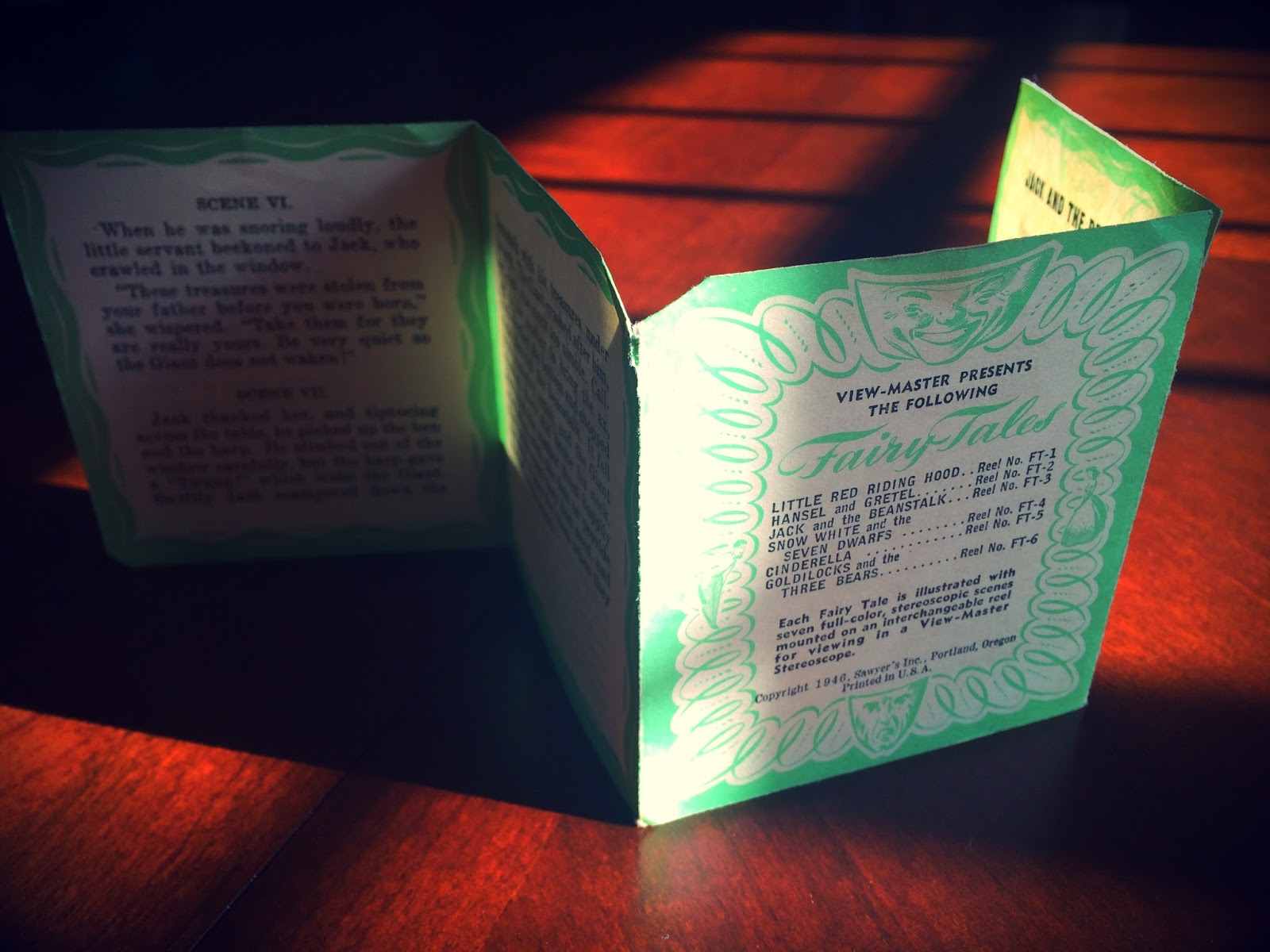
The stories to go along with the images were neatly folded inside the View-Master envelopes and there was nothing more fun than pulling these out for the first time when you got a new View-Master. It was a lot like getting a new record, a new cassette tape, or a new CD, and pulling the sleeve out to read the lyrics.


The stories that we remember from our View Masters include characters from every TV show, movie, or cartoon we knew. This included Snoopy, Herbie, Holly Hobbie, E.T., Star Wars, Adventures of G.I. Joe, Looney Toons and Disney characters, Captain Kangaroo, and more obscure stories like Sigmund and the Sea Monsters.


Of course, Benji made his way into our View Master reels - especially since he had already made his way into our hearts.


I have 3D images forever imprinted in my mind of so many different stories - Winnie the Pooh eating honey, Peter Pan and the Lost Boys trying to escape Captain Hook, the reels that came with the Bicentennial View Master that showed images from 1776, and others. 


Just about any character we remember from the stories or pop culture of our youth probably found their way to these reels.


Even our superheroes would come alive for us in all their dimensional glory....


Some of the images of View Master reels over the decades of the 20th Century were photos, some were in cartoon form, and some in claymation form.  Some were of historical events like the coronation ceremony of Queen Elizabeth.


There was nothing I loved more as a small child than seeing the world in 3D - how I first experienced the sites of America was through my View Master reels. I could feast my eyes on the Golden Gate Bridge hanging gracefully over the San Francisco Bay, the surreal vastness of the Grand Canyon, the stalactites hanging from the ceilings of Carlsbad Caverns, and the palm trees leaning over the Atlantic lapping up onto the Florida Coast.


The larger world became real to me through images, like the tulips of Holland or the pyramids of Egypt.   It was national parks and travel destinations that were the original images on View Master reels from the 1940s....


Since moving to my new Northern California neighborhood a year and a half ago where the tree lines on the horizon don't become red or gold until late fall, I have become friends with a sweet neighbor who is from the Silent Generation, and she has been here since the neighborhood was built in the mid 1970s. This is where she raised her Generation X children, stayed home with them when most moms didn't do this, and even kept her family together in a time when families often didn't stay together. She knows the value of story, and of history, and has kept many of the retro things of multiple generations safely tucked away in her home.  She has kindly shared many of these things with me - to keep in my Gen X retro writing nook, or to take pictures of, or to hold in my hands for a moment and remember. One of these things is her collection of View Masters and reels.


The first View Masters were sold at the 1939-1940 World's Fair in New York soon after Kodachrome color film was invented.  Some of the pieces of my friend's collection date back to the era of her early childhood - the 1940s. I remember looking at some of these as a child, when friends of mine had gotten these as hand-me-downs from grandparents.


The plastic View Masters I had once held in my hand as a child had been grandfathered by the original metal ones.


During WWII,  the US government commissioned millions of View Master reels from the Sawyer's Co. in Portland to train serviceman how to recognize planes and ships from a distance and for range estimation.


Stories from the View Masters of the 1940s included classic fairy tales, national parks, and celebrity cowboys of the time like Gene Autry.


C.S. Lewis said that some day we become old enough to read fairy tales again.  He also said that we should read books from different eras than the one in which we find ourselves - this is because each era (and generation) is good at seeing certain truths, and liable to make certain mistakes. What I did not know as a child is that when I was learning many of these stories, I was looking back to the 3D images of a decade that was far before my time, and in the case of fairy tales, these images were bringing alive stories that were written in the centuries before my time.


Over time, there have been almost 30 viewer models in every color you can think of, each representing the era it came from. There have been hundreds of different themes for the reels, though the View Master itself has remained basically the same so that any reel made from any decade can be used in any View Master.


When we are long gone, if our civilization is buried in rubble, what will they unearth of our old belongings? How will the history books sum up the 20th and 21st centuries in which we straddled with the timeline of our lives? They will see that we took the stories of the centuries before us and turned them into 3D images, that we took black and white and turned it into color, and that we escorted an analog world into a digital one.


What I know is that the Silent Generation and Generation X had something in common - our stories often faded under the sound of the louder voices of other generations of our time, and that is why, while there is still time, we should tell those stories. What I know is that every generation has a story to pass on to the next one.  When we look at time and generations and the stories that formed us, we begin to see how much the narrative of all of our lives intrinsically connects us.  

When I would look at my View Master as a child, I would look at the enormity of the trees of the Redwood Forest reaching toward the blue California sky or the depths of how far the waterfalls of Niagara Falls were plunging into the water below. I was looking at these images with all those who had the same reels, and even with those who had actually once stood in those places. We are truly are connected, and for all the differences that exist among generations and cultures, we have more in common than we usually realize. From the tulips of Holland to the pyramids of Egypt, nothing we do connects us more than storytelling, nothing connects us more to others than telling our own story, and to listening to the stories of others.


________________________________


Thank you, Louise, for letting me borrow these symbols of time, to photograph them, and to see 3D images again that I had not seen in decades.  Sending you love for the history you have been a part of, and for the story you have lived.  

_________________________________


(c) 2015 writing and photography by Chloe Koffas - all rights reserved 


Friday, September 25, 2015

When the Message Reaches You

"Do or do Not...there is no try."

When Luke Skywalker is having trouble using the force to get his X-Wing out of a swamp he has crashed it into, these are words of wisdom from Yoda. In other words, don't just sort of put some effort into something, really try, make it happen.

That's about as philosophical as it gets, especially when it comes to the movies/pop culture of the formative years of Generation X.

Earlier this year, I was walking past Union Square in San Francisco and this giant heart statue caught my eye...

Artist: Lawrence Noble


So I took a photo, walked around to the back of it, and took another photo....


And as I lowered my camera back down, I saw my own reflection in the words, and I have to say it felt like that specific message had somehow been delivered to me the way a letter is delivered in an envelope.  Maybe that's why it was designed this way, so that if you look close enough, you notice your own reflection and take the words more seriously. I sat down for a while to watch other people look at this giant fiberglass piece, and while some were just taking selfies next to it, I could see other people having the same reaction that I did...feeling as they walked up to it that the message was for them.

As I saw this message I resolved to not just try, but to fully embrace the opportunities that presented themselves to me in the days that followed. Soon after, it was as if the universe began unfolding around me in a way it had never quite done before, and it felt as if I took a huge turn around some corner in the timeline of my life. As fall begins, and as I begin to plan out the rest of this year, I realize that this has been one of the most amazing years of my life - not easy, but amazing.

Sometimes, a moment presents itself for us to change our thinking, for us to resolve to do something, or even to do something differently. Sometimes it is a moment that is profoundly beautiful, sometimes it is a moment that hurts.  Sometimes we stumble upon these moments so that we can turn a corner, or change direction, and it is these small moments than can change the trajectory of our lives.

_______________________________________________

This sculpture was painted by Lawrence Noble who has made numerous Star Wars sculptures, some for Lucasfilm.  This piece has been part of a charity drive to benefit San Francisco hospitals.


Photos and writing by Chloe - 2015