Showing posts with label Challenger Disaster. Show all posts

Monday, January 25, 2021

Eight Points of Light


Our planet hangs suspended in a cold and elegant universe. Shadowed by sorrow, but aglow with profound beauty, we look out at it with eyes that only see slivers of a fuller picture. Late January is a painful time each year for those of us who experienced an event in 1986 that altered our lives. We may awake somewhere in America with frost on our window panes or we may remember the icicles that had quietly formed on the Challenger in the early morning of January 28th as it sat ready to launch. Either way, we feel that threatening chill from 35 years ago once again.   

Leslie Ebeling Serna, the daughter of Bob Ebeling, the engineer most well known for trying to stop the Challenger disaster, reached out to me last summer in response to a letter I had sent. Leslie's life was very much affected by the disaster, she and her father were working for Morton Thiokol, the company that made the shuttle's rocket boosters in Utah. She remembers the windows in nearby houses shaking as the parts were being tested out on the open land. 

photo credit: Alicia Petresc


From 1970's Starry Skies to 1980's Launches

I lived not so far away from Utah in the late 1970's. My greatest joy was when my father would carry me on his back in our yard from where we would look up to the brilliant Albuquerque night sky. We were in a desert city yet to sprawl, there was still so little glow from the city lights, we could see what seemed like a million stars.

As the 1970's became the 1980's, the NASA shuttle era began and my love for the beauty of the universe grew. I was full of wonder when I heard the Reagan Administration had announced sending a teacher to space as part of the shuttle crew.

The Challenger launch was one of the most impactful experiences for the younger wave of Generation X, and for those of us in mid to late elementary school, we were old enough to grasp the significance of the day and still tender enough to be deeply wounded by it. 

photo credit: NASA


We watched the launch on live TV from a classroom. Seventy-three seconds later, the twisting contrail imprinted itself as an image of horror onto the life-long consciousness of my generation. One moment's excitement led to the next moment's confusion and fear; we found ourselves suspended in a place between life and death. 


For months, as the crew prepared for the launch, we had talked about them constantly on our playgrounds and in our classrooms. Soon enough we held them in our hearts, and then, in one day, we lost all seven. 


photo credit: NASA

 Hundreds of letters to Bob Ebeling

And all of this loss is why, even all of these years later, I needed there to be a hero somewhere in the bigger picture of this story - someone who tried to stop this day from happening. This is why I needed to know about Bob Ebeling. No one worked longer or harder at trying to stop the disaster than he did. He spent an entire year trying to convince the managers at NASA that it wouldn't be safe to launch. He didn't want to see people die or for school children to witness a tragedy. But the president wanted it, the pressure to launch was high given the repeated delays, and the warnings that Bob and other engineers gave about launching in such frigid temperatures were ignored. Bob even went so far as sending out a memo titled "HELP."
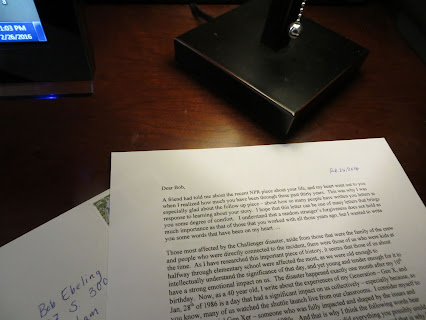


Five years ago, an NPR article described how Bob was still carrying the weight of the disaster on his shoulders even 30 years later. While he tried to stop it, he blamed himself and felt he should have done more. A second follow-up article told of the response of empathy and support from people by the hundreds in letters and phone calls. This was mainly to tell Bob that he had done the best he could to avert the disaster, and that he was forgiven because he needed to hear those words, even though there really was nothing to forgive. After carrying this heavy burden he took upon himself, he was finally able to lay it down at the end of his life. Four years later, his daughter Leslie was going through some of her parents' old correspondence, and then emailed me about one of those letters - the one I had mailed to him. Out of those hundreds of letters, it was an extraordinary honor to get a response, and the odds were one-in-a-million that we would connect, as she chose just one letter to respond to. What I didn't mention in the letter was that my father was one of the leads working with NASA in Houston to make sure what led to the Challenger disaster would never happen again -- I didn't realize that until later. 

String Theory and the Way our Lives are Tied Together

Physicists describe things at the most granular level, like atoms, with quantum mechanics, or things at the most macroscopic level, like stars, with general relativity -- but these groups usually work independently of each other. String theory is an attempt to reconcile these vastly different worlds, toward a solution that can provide a fuller understanding of our universe.

photo credit: javardh

 I could not understand the fuller story of how the Challenger disaster affected my life until I understood the way it had affected other people, like Bob and his daughter Leslie, who is now a very dear friend. She was there for him and with him the fateful day this all happened, and as she saw his struggle and his suffering, it brought them closer together. In gaining a better understanding of this, I was able to do the same with my own father more recently. We need each other's stories to understand our own. In taking a look at Bob Ebeling's journey and how he affected NASA, I was doing some reading on this, which, amazingly, led me to the work of my own father. While I knew my dad had worked as a NASA contractor in Houston many years after the disaster, focusing on safety certification, I thought it had more to do with on-the-ground operations. While I knew he had done some work involving the International Space Station, I had missed that he was doing so much for the safety of astronauts. It was the Ebeling family getting in touch with me that led me on a journey of understanding where my own family fit into this bigger picture. 

photo credit: Josh Gordon

I had never connected the dots on any of this until Leslie reached out to me. This was both astonishing and redemptive for me, as the Challenger disaster altered my childhood and overshadowed my outlook on life. It was where my distrust of institutions began, it was when my cynicism began. Five years ago, I had written a piece about how this affected my generation, not realizing my father had worked to make this right. Of all the ways I had wished my father could have been there for me, what I can hold onto is that he did this extraordinary thing for all of us who experienced the disaster that day. And because of this, the story, which is always so much larger than what we initially see, can end well. In writing the words, "I forgive you" to Bob, I was forgiving my own father at the same time. 

Heavy Burdens and Heroism

We carry heavy burdens for decades, often those burdens aren't even our own - they are other people's selfishness and careless decisions. Bob carried the burden of others' choices on himself for 30 years. When I was a child, I thought that heroes were the people who showed up at just the right moment to do something amazing or to stop a catastrophic event from happening. Now I realize heroes are the people who do the right thing in the moment, who speak truth to power, and, regardless of the outcome, are still heroes. I now know they are the people who often carry the heaviest burdens of anyone. 

photo credit: NASA


Lunar Rocks and Stained Glass

We take January to look back on a crisis as we live through an era of enormous crises. A lunar rock brought back on Apollo 11 was gifted to the American National Cathedral and embedded in the stained glass. Today the cathedral's bells ring out in memory of Americans lost to the pandemic. Each peal honors a thousand lost lives. By the end of 2020, the daily death toll from Covid-19 was the equivalent of 16 fully loaded 737 jets falling out of the sky. As we start 2021, the numbers continue to rise. The dean of the cathedral reminds us that we are commanded to love one another, that we are not lone individuals free from responsibility - we are dependent upon one another for our very lives. 


The Way Light Travels 

In previous years in the later part of January, I have lit candles for each of our seven fallen heroes. 

This year, I lit eight, adding one for Bob Ebeling and his courageous effort to stop the disaster, and for the struggle in carrying the burden of the disaster afterward.

I set the eight candles on the brick edging of my pool.  The flames flickered in the night breeze.

And then I noticed the reflection of the moon and stars in the water, so I took a picture of the candles from above. The candles glowed  like planets reflecting the brightness of the sun. 

Light from the other corner of the galaxy will travel for millennia before reaching our eyes. It can take us decades to see the bigger picture of our lives, the redemption, the part in the story where things start to get better. Astrophysics tells us that we are all made of the substance of stars. We can map those elements across the Milky Way. Maybe this means that sooner, if not later, we will all find our way back to love, our oneness with each other. In the wake of a supernova, there is this incredible brightness, not in spite of, but because of a cataclysmic explosion, and this is where new stars are formed. Light fills the universe. As the universe expands relentlessly, so does the human story, so does the light, so does the way each of our stories are connected to each other. 

___________________________________

Afterward:

 
Bob was one of five engineers, including Roger Boisjoly, who warned of the impending disaster. Leslie carpooled with her father to work, and on January 28, 1986, as the disaster happened, she was right by his side. Leslie has done so much to honor her father's memory and integrity. When I asked her what she wants people know about Bob, she said she wants them to know that he was brilliant, and that he was a great father who provided well for his kids. She said that he
 gave them good childhoods full of opportunity and culture, sight-seeing, music lessons, hunting, fishing, skiing, and camping. She said he was very much involved in his kids' lives. 

After the Challenger disaster, Bob retired. He put his efforts and engineering experience into nature conservation. Among the multiple awards he received, President Bush presented him with the Theodore Roosevelt Conservation Award in 1990 for his work. Bob was also a WWII veteran. He married his kind and generous wife Darlene in 1949 and five children followed. She was the love of his life. 

Bob with family, Leslie at his side - early 1960's


Years back, both Bob and Leslie were interviewed by 60 Minutes - there was a pause for a quick photo that day: 


Leslie (center) with Lesley Stahl (right)
 and her assistant (left)


The recent Netflix series, Challenger: The Final Flight gives a fuller picture of the way this piece of history unfolded in the mid 1980's. 
Leslie is one of the people interviewed in the series.

There are parallels between the 2003 Columbia disaster and Challenger, resulting in the loss of 7 astronauts once again. Employees/contractors gave warnings that NASA refused to acknowledge. Something clearly needed to change. In the years that followed, my father came to NASA initially to do risk management through Futron, a NASA contractor, and then as an Environmental, Safety, and Health Lead with Lockheed Martin. He led the OSHA Voluntary Protection Program (VPP) certification process at NASA for Astronaut Training and Mission Control. He and others helped create a better system of communication so that employees on any level could be heard, especially when lives are in danger. While the Challenger Disaster cast a long shadow over my childhood, and that of my friends and generation, it is redeeming to know that my father worked to prevent this from happening again. A message I was able to pass on to Leslie and family from my father was this: What Bob did affected the entire culture of NASA going forward.  

Thank you to my dad, Gary Craik, for all of your hard work on this at NASA. 

And thank you to Leslie Ebeling Serna who became like a sister in the process of this extraordinary journey -- I only saw the bigger picture of this story because of you. 


___________________________________


My dad and I when I was at the age when he 
would lift me up to see starry night skies. 


___________________________________________________

Sources

The Elegant Universe, Brian Greene

Cathedral.org press room - American Mourns 300,000

Space.com - Humans Really are Made of Stardust and a New Study Proves It

Articles by Howard Berkes: 

NPR.org: 30 Years After Explosion, Challenger Engineer Still Blames Himself

NPR.org: Your Letters Helped Challenger Shuttle Engineer Shed 30 Years of Guilt


Weekly Reader - March 7, 1986


And one more note: while visiting with my friend Louise at her house last summer, her small granddaughter randomly picked up a book from the shelf and shook it, and out onto the front porch fell the Weekly Reader article that had been hidden within for almost 35 years! I'd been hoping to find this for so long - an original copy of one of the same ones that young Gen Xers read in our classrooms in 1985-86. As soon as this emerged, I had a feeling someone would be contacting me soon about the Challenger. Just a few weeks later, Leslie emailed me and this whole journey began.  Thank you, Louise! 


_____________________________

(c) 2021 by Chloe Koffas - all rights reserved 


Photo credits:

AP - picture from Weekly Reader above  

NASA photos posted are public domain 

Artistic photos by photographers on Unsplash.com, names credited in photo captions

Family photos posted with permission from the Ebeling family

additional photos my own 


Thursday, January 28, 2016

The Challenger Disaster and Generation X


As the sun rose on America that January morning, some cities lay quietly under a blanket of snow, and while the Atlantic waters lapped onto the shores of the Southeast, a threatening chill arrived with them.


As the 30th anniversary of the Challenger Disaster is commemorated and the events of that day surface once again in the media, for some of us of a certain age, the tragedy of that day is with us all the time


I was a child of the '80s, and in the months leading up to that day, the Challenger was constantly on my mind - like in the afternoons when I would run in circles and land on my back in soft green patches of clover in the park near my house. Through my nine-year-old eyes, I'd look out to the infinite blue of the universe, to the east where shuttles are launched, to where impossible things seemed possible, even if just for one minute.


In the mid '80s, while the members of Generation X were growing up, modern American public educations standards were at an all-time low. The Reagan Administration saw the upcoming Challenger launch as a way to remind the nation of the important role of teachers and maybe to reboot hope in the American school system. Out of thousands of applicants to the Teacher in Space Project, the charismatic Christa McAuliffe was chosen. Those of us in elementary school closely followed these events from sources like NASA and Weekly Reader, so that these people would continually be on our minds, so that they could, in every sense, become our heroes, so that we could know their stories and their lives, so we would love them.

The pint sized propaganda was delivered to our desks every week, and we drank every drop of it.  By design, the anticipation of the launch hit every major nerve in me - the women among the crew became role models to the Cabbage Patch-carrying girls of the 1980's.


In this Morning in America era, every kid you knew was dreaming of being an astronaut. On the playground, we would tell each other which of the seven was our favorite. In one way or another, every one of the seven carried with them the hopes and aspirations of our generation. Whenever I have asked fellow Gen Xers about their recollection of that day, those in elementary school were often the most impacted. Those about halfway through elementary school, like myself, were old enough to intellectually grasp the significance of this day and yet were still young and tender enough for the event to inflict powerful emotional damage. Because the Challenger launch became synonymous with our education and our hope in our future, the tragedy of that winter day is one of the main reasons my generation instinctively distrusts institutions. While there was a spectrum of responses to the event, ranging from confusion to grief, the school kids affected the most will tell you that day changed their lives. I can tell you that it changed mine. It was a day that left my generation standing alone, in a "sunlit silence".

Custom watercolor by Emblaester, artist on Fiverr.com

If I allow my mind to fully go back into the moments of that day, it is hard to breathe. I can still feel the chill of that morning on my skin from where I was two time zones away from Florida in the high altitude desert of New Mexico. I saw it live on TV from a classroom, along with millions of other kids, and watched quietly as the twisting contrail imprinted itself as an image of horror onto the collective consciousness of my generation, like some coiled up snake that struck without warning. Palpable feelings of excitement degenerated into confusion and then anxiety; and then the teacher abruptly shut off the TV. We were told that it was over and to get back to our desks. In that moment that I was supposed to stoically return to school work, I found myself caught in some delicate place between life and death, somewhere between hope and hopelessness. It took me the whole day to process what had happened, and as I did, an emptiness hovered above my head, above my school, above my country.


So much dialogue was happening in our classrooms in the months leading up to that day about how anything was possible, that we could be astronauts, that we could be anything we wanted when we grew up, and that the shuttle launch was going to be the moment that would demonstratively prove this to us. When the moment defining how anything was possible went entirely wrong, I felt panicked to my core - maybe my future was going to be dark, maybe my dreams would be swallowed whole with no explanation. Not only did our heroes die that day, but a lot of our hope did, and much of this hope was replaced with fear about the future - an anxiousness that has stayed with us our whole lives. Many of the traits that Generation X is known for, from our negativity to our cynicism, can be traced back not only to the state of society in our formative years, but to the exact date of January 28, 1986.

That evening, millions of us gathered around TVs once again, and this time it was to watch Reagan deliver a speech about the catastrophe. His words made the event unbearably real, and while he spoke, my heart was forced to shift from somewhere within the first stage of grief, denial, to somewhere within the dark gravity of the next stage of grief - anger. The only words from the speech that gave me any comfort were that our fallen heroes had "touched the face of God." When he quoted the poetry of aviator John Gillespie Magee Jr. in the speech, I did not know that he, too, had died at a far too young age - during WWII. I could not yet fully know of the service and suffering of the GI Generation before me, of all who had lost their lives in order to pass on freedom before my own generation was ever born.  And what the older generations did not know, was that, as icicles formed around the shuttle that night before, that the world had already had become a much bleaker place than the one they thought they passed on to us, and when morning came, the disaster confirmed it.


In mourning the death of Christa McAuliffe, the Generation X student body of her school came together for a memorial service in the school gym.  "Life in a Northern Town" by Dream Academy was the song that concluded the service. While this song is a quintessential piece of Gen X music, the lyrics actually reference the experiences of Christa's generation - the Boomers. In the song, it mentions that in the aftermath of JFK's assassination, "it felt like the world would freeze."  On January 28, 1986, it did.  Society told Generation X who our heroes should be, and made us love them. And from our schools we watched our heroes perish, so that no place, not even the familiarity of our own classrooms, not even the "high untrespassed sanctity of space" seemed safe after that. All my heroes were taken away from me that day.  In front of my eyes. All seven of them.

On January 28th, 1986, Gen X witnessed the launch and loss of a shuttle crew, just as we watched our parents' marriages dissolve, just as we watched society dissolve. That decade, educational quality had trended to an all-time low and divorce rates had reached an all-time high - and those statistics weren't just numbers, they were our families. As Generation X was growing up, there was this idea that kids should fend for themselves, solve their own problems, and more or less raise themselves. Society told parents they should be considerably more concerned with self-actualization or self-fulfillment than with parenting. Ten miles above the earth there was a structural failure that took seven lives, and meanwhile, on earth, there was a structural failure in how a generation was being raised. Generation X wasn't just the latchkey children of broken homes, we were the latchkey children of a broken society. Something is truly wrong when children are conditioned over a long time to anticipate an event, and are told that their own futures are tied to this moment, only to watch that event unfold like some kind of nightmare.  "Obviously, a major malfunction" were the words of the NASA launch commentator. Those words haunt us, because, in many ways, it not only articulated a moment that we were unprepared for, but also defined the background of our formative years, and even, in some ways, our entire lives. Gen X grew up too fast and any lingering naivety dissipated alongside the vapor of the shuttle that day.

We study history to learn from it and to not repeat its mistakes. Let us, as a society, as human beings, never let another January 28, 1986 happen again - not to heroic explorers, not to children whose hope in the future is hinged on a moment that could have been full of possibility, but instead was full of malfunction and fear. It altered the collective psyche of my generation - how we see the world, our lives, and our futures. We are still mourning. That day for us, for Generation X, was the day that the world froze. It affects who we became and how we see the world, thirty years later.


______________________________

A Journey to the Challenger Memorial in Palo Alto, California, January 2016...the seeds from these Redwoods orbited the earth in the Challenger Shuttle one mission before the disaster took place, and here are several photos I took of the park:


My family and I went here to remember the day in 1986 that forever altered history, to remember the seven people we lost that day. This small memorial grove sits in the back of a park.    

As I approached this grove of trees, a train was speeding by just behind here and at the same time, I could feel my life speeding before me, flashing through my mind were the images of my whole life. It was as if my soul was trying to tell my mind how pivotal this experience was to the entirety of my life and my being.


Redwoods stand in a circle - one for each of the astronauts. To stand in the very middle of these trees is powerful.  You get the feeling someone, or several someones, are watching over you. From the large branch that had fallen in the middle, I took some small pieces home with me as a memento. 


Each tree is numbered, coincidentally, or maybe not so coincidentally, 
with the birth years of Gen Xers. 


Such an extraordinary piece of history and of science. Experiments are an important part of shuttle missions and the seeds from these trees were part of an experiment - they were in the aboard the Challenger and orbited the earth over a hundred time as we experienced the summer of 1985. To physically walk up to a space that represents, or even encompasses an event that altered your life is intense.  Many say that the Challenger Disaster is one of the events that most affected Generation X. Many also say that it is the event that most affected us.


To stand above this stone on a California overcast day while reading the words between the cracks brought me several tears. A weathered piece of metal mounted on a large rock reflects three decades of facing an usually blue sky.  


"These redwoods grew from the sees of El Palo Alto that orbited Earth on board the Space Shuttle Challenger STS-51F July 29th - August 6, 1985. On a later mission, Challenger and the lives of seven astronauts were lost in an explosion on January 28, 1986."


Redwoods can live for a thousand years or more - I wonder if the story of these trees will.  I hope so.


________________________


(c) 2016 by Chloe Koffas - all rights reserved.
NASA photos: public domain, writing and other photography by Chloe Koffas, words in quotes from the poem, High Flight by John Gillepie Magee Jr. 

Many thanks to my dear friend, Jennifer McCollum, who hired the artist to do the watercolor classroom picture of January 28, 1986 above. What an extraordinary gift ~

Link to lyrics: Life in a Northern Town
Link to poetry: High Flight

Monday, January 28, 2013

The Gen X Chronicles: Part Six - The Challenger

January 28, 1986: The launch and structural failure of the Challenger Space Shuttle.

As far as events that happened on American soil that affected the American Gen X psyche the most, this would be one of the most important - some would even say the most important.

The Reagan Library and Museum in Simi Valley, CA is what I refer to as "The Gen X Chronicles" because it documents many of the world events that happened during the formative years of Generation X which is a big piece of our collective experience. One section of the museum focuses on the Challenger launch.  Gen Xers on the East Coast remember this event happening around noon of their school day. For Gen Xers like me who lived further out west, we remember this happening in the morning, with most of the school day ahead of us. We remember the strangeness of going through the motions of the rest of the day when an enormous catastrophe had happened. The structural failure of the Challenger and the simultaneous death of seven American heroes that all of us school kids had spent so much time getting to know from our classrooms, left an enormous impression on us. 

Below is the Challenger Space Shuttle in a fleeting moment of exquisite beauty - clear blue sky, and an explosion of heat that was meant to propel those on board to the stars. Did these birds, rising up in their choreographed movement with the lift-off know that disaster was only moments away?


Though parts of that day are now hazy for me, I am able to recall moments of it with intensity - the moments that were the heaviest with the most sorrow and confusion are the moments I remember most clearly. I remember that all of us at my elementary school were very unprepared for what happened. For some reason, I was a visitor that day in a different classroom than my own, the one next door to mine, and I remember being gathered with other kids around a TV full of anticipation. When the unthinkable happened before our eyes, the teacher became clearly upset and very quickly shut off the TV. Through the eyes of a child, I interpreted her response as anger at us as she abruptly told me and others to leave her room immediately and go straight back to our regular class. I couldn't completely process what was happening. I couldn't figure out why we she was so agitated at us, and I couldn't figure out what we had done wrong. Through the eyes of an adult, it is clear that she was holding in a huge amount of emotion and was trying not to cry in front of us. She was in a very difficult and awkward situation. The walk back to my regular classroom was also very awkward. Because I could not process everything and because the shuttle images on the TV had gotten turned off so fast as I watched them, there was a part of me who thought maybe everything was still okay, that the explosion we saw was maybe just coming from some piece of debris that had fallen off the shuttle, and that everything was going as planned. It took the rest of the school day for me to slowly process the tragedy that had happened, and the whole day felt surreal. After a very long time of anticipating this amazing day and moment, it all came to an end in a way we hadn't expected. A certain emptiness hovered above my head, above my school, and above my country. 


A few weeks later I wrote letters of consolation to each of the seven families. So did a lot of people.

This is the footage being played next to this exhibit - the 1/28/86 presidential address that many watched as they were experiencing the shock of the event... 

Just after the two minute point of the clip is his message to us as Gen X kids: "...the future doesn't belong to the fainthearted, it belongs to the brave...." When I look at what my generation had to endure in the following decades all I can say is that those words proved to be true:


I used to walk through museums as a child and wonder why old people would be quietly shedding tears in corners after seeing mementos of some war or time in history that they had personally experienced. Back then, life for me was new and I had almost nothing to look back on. After seeing images of things that have affected me personally at museums or in documentaries, I am now the one trying to hold back the tears. This was just one of many crises that would play out in the lives of Gen Xers. 


To those who saw the launch of the Challenger in pixels, and to those who saw this in person, you did not experience this alone.  We all experienced this together. 


_________________________________________________________________________________

(c) 2012 Writing and photography by Chloe, original photography from the Ronald Reagan Library and Museum, Simi Valley, CA.