Showing posts with label C.S. Lewis. Show all posts

Sunday, December 31, 2017

Messages from the Lost Generation to Generation X: A One Year Journey


Gen X's Connection to the Lost Generation

While the late wave of the Lost Generation experienced the last years of their lives, Generation X experienced their earliest years. They were the red leaves that had hung on through the worst heat of summer, while we were the green blades of grass shooting up toward the sun, only just realizing how cold the coming winter would become. As I've been on a one-year journey to find the Lost Generation, I have sought their wisdom. And I have realized that these leaves, this generation, even as they fell, were often trying to protect us or give to us in whatever way they could. When I was a small child, my Lost Generation great-grandfather had brought me a seedling tree from Illinois, down Highway 35, and across I-40, and planted it in our front yard. In the summer, it had shadowed me as my pinwheel blew in the soft breeze and, when fall came, it dropped its leaves in the street like little treasures.

When Ethan Hawke's character picks up the phone in Reality Bites and says, "Hello, you've reached the winter of our discontent," he isn't just alluding to the crisis that Gen X remembers as kids, he is reaching back in some way to Steinbeck.

Sinclair Lewis summed up the experience of the Lost Generation: "Winter is not a season, it's an occupation." As generations go, every four cycles is a 'lost generation', and the history that goes with those cycles is always winter, always discontent. This was life for the Lost Generation, this has, in many ways, been life for Generation X.

Why it matters to understand a previous generation is that it helps to better understand our own. Why it matters to study history is so that we don't keep repeating the same mistakes. We are still very much affected today by issues of the Lost Generation. History, as we experience it, is even continuously altered by WWI. One all too real example of this is that many bombs, designed to explode on impact, were left behind in the fields of Europe as the tired arms of soldiers sometimes laid them in the grass and walked away. Today, as farmers plow fields, or as people walk by, those bombs sometimes explode and those people are sometimes injured or killed, even though it is now a hundred years later. This is known, darkly, as the Iron Harvest.

Another chilling example of our connection to the Lost Generation is H1N1. In the winter of 2009, this virus was constantly in the news as a potential pandemic. We stood in line at a clinic for shots in the freezing cold, while volunteers handed us warm blankets. The Red Cross sign on the side of their truck had me thinking about the way they had helped relief efforts during WWI, but I did not know that what we were about to get immunized for was a variation of the same flu that wiped out a large number of the world's population a century before. Sadly, the Lost Generation was born during years that made them more susceptible to this horrible virus because of a different flu they had gotten as children. 

If you are Generation X, you may have known and loved people from the Lost Generation - I surely did. One thing that became more and more clear to me through this year of searching for them, for their wisdom, for their messages left to us, is that they saw our suffering, and knew our suffering because it was painstakingly familiar to them. Their lives were coming to an end as ours were beginning so they were often unable to intervene in our lives or help us in a way they could have if they had been younger, though I think they often did what they were able to in the time they had left.

The Lost Generation lived through a similar pattern of history, and therefore had a similar struggle that Gen X has now, and any wisdom or hope they left behind helps us on our own long journeys. Some of those messages are quoted on this blog over the past year. Beyond that wisdom, these are the two messages I found from them that have affected me the most....

How to Fight

One of those messages is the example they left us of how to fight. There were two well-known truces that took place during WWI: The Christmas Truce of 1914 (which would have been a day that would have the most meaning to soldiers on the Western Front) and the Easter Truce of 1916 (a day that would have the most meaning to soldiers on the Eastern Front). In both cases, soldiers stepped out of their trenches and broke bread with the other side, an act that included both risk and profound love. Many other small, localized truces took place during the war as well. This was a powerful message from the Lost Generation to us: we should always take a moment to see those we consider an enemy as truly human, or even if just for a moment, as brothers and sisters.

How to Have Hope

C.S. Lewis, one of the brightest voices of the Lost Generation, told us the reason our heart yearns for something earth can't supply is proof that heaven must be our home. This is the ultimate hope and the ultimate explanation for why we feel lost, because we are not yet home. This image of hope and light shows up in different ways in the writing of the Lost Generation - it was the green light that the Great Gatsby reached toward over the water, it is the lighthouse that Virginia Woolf told us to look toward.

Here's to the coming new year, when we look toward hope. It will be exactly one century from the year that WWI came to an end. In November of 2018, a centennial memorial for American WWI veterans will finally be opened. Up until now, the veterans of every other major war have been given a monument in Washington D.C., the Lost Generation has not. 

This is exactly what it means to be a lost generation.

May the Lost Generation rest in peace. And while we've said it for generations, it is always worth saying it again:
Peace on earth.


(c) writing by Chloe Koffas 2017, photos by Chloe, Portland, Oregon


Sources:

Time Magazine: Solving the Mystery Flu That Killed 50 Million People
WWI Centennial Memorial Info and a link to donate
The Sun Also Rises, Ernest Hemingway
Wikipedia: Iron Harvest 
An Easter Truce, 1916: Gateways to the First World War


Sunday, November 15, 2015

Generations of the View-Master


There's something about this time of year...when the morning chill makes its way through the turning colors of the leaves, and as we turn to our Charlie Brown and Rankin Bass holiday specials, a certain nostalgia rises up within us. This is the time of the year where find ourselves making holiday shopping lists for remakes of retro toys we once had as Gen X kids or pulling down our own retro toys from our shelves for the kids in our lives who come to visit us.


In 1976, it was the Bicentennial of America, and everything around us from the pot holders in our harvest gold kitchens to the fire hydrants on the streets became red, white, and blue. The View Master model that year was also one of those things....


This was the most beloved toy of my early childhood.  When I would lift the lenses to my eyes, it created a certain magic. The sun would send its slanted rays onto the shag carpet of my bedroom and I could lose myself in another world as I pulled the reels out of its round canister. I would lose all sense of time and a whole afternoon would disappear into moments.


This is the time of the year when the most epic stories usually make their way to the movie screens in theaters and in our homes - when we are more likely to be indoors, when we are more likely to look inward, or to take a moment to look back. The beauty of storytelling always seems to come alive around the holidays.


When the 1970s rolled into the 1980s, the kids of Generation X kept on using our Bicentennial View Masters to view the new pop culture that came at us in a new decade.


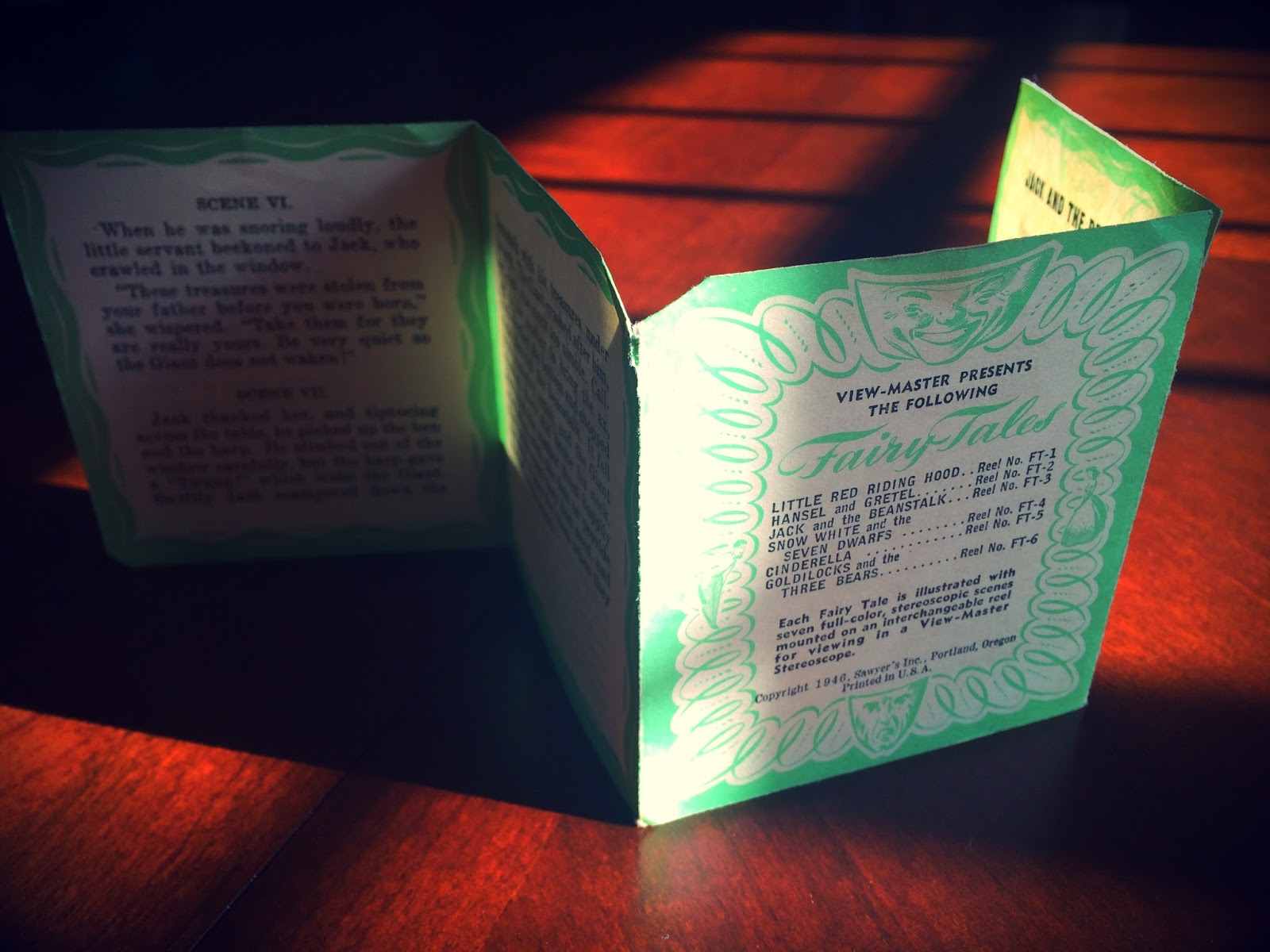
The stories to go along with the images were neatly folded inside the View-Master envelopes and there was nothing more fun than pulling these out for the first time when you got a new View-Master. It was a lot like getting a new record, a new cassette tape, or a new CD, and pulling the sleeve out to read the lyrics.


The stories that we remember from our View Masters include characters from every TV show, movie, or cartoon we knew. This included Snoopy, Herbie, Holly Hobbie, E.T., Star Wars, Adventures of G.I. Joe, Looney Toons and Disney characters, Captain Kangaroo, and more obscure stories like Sigmund and the Sea Monsters.


Of course, Benji made his way into our View Master reels - especially since he had already made his way into our hearts.


I have 3D images forever imprinted in my mind of so many different stories - Winnie the Pooh eating honey, Peter Pan and the Lost Boys trying to escape Captain Hook, the reels that came with the Bicentennial View Master that showed images from 1776, and others. 


Just about any character we remember from the stories or pop culture of our youth probably found their way to these reels.


Even our superheroes would come alive for us in all their dimensional glory....


Some of the images of View Master reels over the decades of the 20th Century were photos, some were in cartoon form, and some in claymation form.  Some were of historical events like the coronation ceremony of Queen Elizabeth.


There was nothing I loved more as a small child than seeing the world in 3D - how I first experienced the sites of America was through my View Master reels. I could feast my eyes on the Golden Gate Bridge hanging gracefully over the San Francisco Bay, the surreal vastness of the Grand Canyon, the stalactites hanging from the ceilings of Carlsbad Caverns, and the palm trees leaning over the Atlantic lapping up onto the Florida Coast.


The larger world became real to me through images, like the tulips of Holland or the pyramids of Egypt.   It was national parks and travel destinations that were the original images on View Master reels from the 1940s....


Since moving to my new Northern California neighborhood a year and a half ago where the tree lines on the horizon don't become red or gold until late fall, I have become friends with a sweet neighbor who is from the Silent Generation, and she has been here since the neighborhood was built in the mid 1970s. This is where she raised her Generation X children, stayed home with them when most moms didn't do this, and even kept her family together in a time when families often didn't stay together. She knows the value of story, and of history, and has kept many of the retro things of multiple generations safely tucked away in her home.  She has kindly shared many of these things with me - to keep in my Gen X retro writing nook, or to take pictures of, or to hold in my hands for a moment and remember. One of these things is her collection of View Masters and reels.


The first View Masters were sold at the 1939-1940 World's Fair in New York soon after Kodachrome color film was invented.  Some of the pieces of my friend's collection date back to the era of her early childhood - the 1940s. I remember looking at some of these as a child, when friends of mine had gotten these as hand-me-downs from grandparents.


The plastic View Masters I had once held in my hand as a child had been grandfathered by the original metal ones.


During WWII,  the US government commissioned millions of View Master reels from the Sawyer's Co. in Portland to train serviceman how to recognize planes and ships from a distance and for range estimation.


Stories from the View Masters of the 1940s included classic fairy tales, national parks, and celebrity cowboys of the time like Gene Autry.


C.S. Lewis said that some day we become old enough to read fairy tales again.  He also said that we should read books from different eras than the one in which we find ourselves - this is because each era (and generation) is good at seeing certain truths, and liable to make certain mistakes. What I did not know as a child is that when I was learning many of these stories, I was looking back to the 3D images of a decade that was far before my time, and in the case of fairy tales, these images were bringing alive stories that were written in the centuries before my time.


Over time, there have been almost 30 viewer models in every color you can think of, each representing the era it came from. There have been hundreds of different themes for the reels, though the View Master itself has remained basically the same so that any reel made from any decade can be used in any View Master.


When we are long gone, if our civilization is buried in rubble, what will they unearth of our old belongings? How will the history books sum up the 20th and 21st centuries in which we straddled with the timeline of our lives? They will see that we took the stories of the centuries before us and turned them into 3D images, that we took black and white and turned it into color, and that we escorted an analog world into a digital one.


What I know is that the Silent Generation and Generation X had something in common - our stories often faded under the sound of the louder voices of other generations of our time, and that is why, while there is still time, we should tell those stories. What I know is that every generation has a story to pass on to the next one.  When we look at time and generations and the stories that formed us, we begin to see how much the narrative of all of our lives intrinsically connects us.  

When I would look at my View Master as a child, I would look at the enormity of the trees of the Redwood Forest reaching toward the blue California sky or the depths of how far the waterfalls of Niagara Falls were plunging into the water below. I was looking at these images with all those who had the same reels, and even with those who had actually once stood in those places. We are truly are connected, and for all the differences that exist among generations and cultures, we have more in common than we usually realize. From the tulips of Holland to the pyramids of Egypt, nothing we do connects us more than storytelling, nothing connects us more to others than telling our own story, and to listening to the stories of others.


________________________________


Thank you, Louise, for letting me borrow these symbols of time, to photograph them, and to see 3D images again that I had not seen in decades.  Sending you love for the history you have been a part of, and for the story you have lived.  

_________________________________


(c) 2015 writing and photography by Chloe Koffas - all rights reserved